
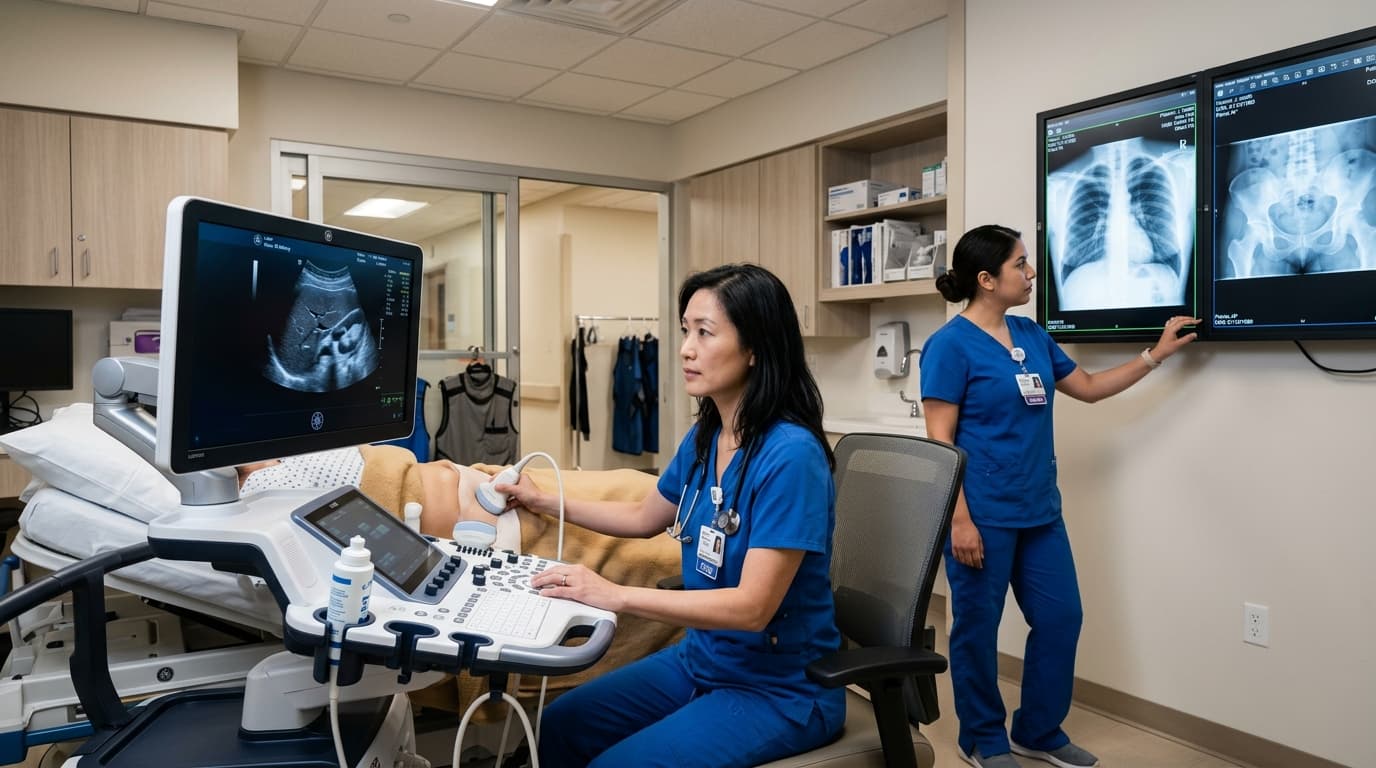
Radiography and Imaging Technology (BS-RIT)
An advanced 4-year degree in modern diagnostic imaging, CT scanning, MRI imaging, diagnostic ultrasonography, and fluoroscopy procedures.
Program Overview
The Bachelor of Science in Radiography & Imaging Technology (BS-RIT) trains high-caliber medical radiation and diagnostic imaging technologists. The curriculum combines radiological physics, radiation protection, sectional anatomy, computed tomography (CT), magnetic resonance imaging (MRI), vascular angiography, and diagnostic ultrasonography, preparing graduates to operate advanced imaging systems safely and accurately.
Why Study Radiography and Imaging Technology (BS-RIT) at Pak Royal College?
Modern Diagnostic Powerhouse
Nearly every medical diagnosis relies on imaging; radiologists require qualified technologists round-the-clock.
Advanced CT & MRI Training
Hands-on rotations on high-slice CT scanners and 1.5T/3T MRI machines in affiliated hospital radiology departments.
Global Radiation Licensure
Curriculum matches international radiography accreditation standards, enabling smooth credentialing in the Gulf, UK, and Australia.
Comprehensive Sonography Exposure
Learn abdominal, pelvic, vascular, and small parts ultrasonography principles directly from diagnostic radiologists.
Academic Curriculum & Semester Breakdown
Explore course codes, credit distribution, and practical lab components across each academic semester.
| Course Code | Course Title | Credit Hours | Course Type |
|---|---|---|---|
| RIT-101 | Human Anatomy I | 4 (3+1) | Core Science |
| RIT-102 | Human Physiology I | 4 (3+1) | Core Science |
| RIT-103 | Radiation Physics & X-Ray Production | 4 (3+1) | Foundation |
| ENG-101 | English Composition | 3 (3+0) | General Education |
| ISL-101 | Islamic Studies / Ethics | 2 (2+0) | General Education |
Program Learning Outcomes
Advanced Computed Tomography (CT)
Protocol selection, contrast injection parameters, multiplanar reconstructions (MPR), and 3D volume rendering.
Magnetic Resonance Imaging (MRI)
T1, T2, FLAIR pulse sequence optimization, RF safety protocols, and musculoskeletal/neurological imaging.
Radiation Dosimetry & Protection
Strict adherence to ALARA, beam filtration, lead shielding, and occupational radiation monitoring.
PACS & Image Archiving
Digital radiography workflow, DICOM protocol standards, and hospital picture archiving systems.
Skills & Technologies You Will Master
Where Can This Degree Take You?
Potential career trajectories and roles pursued by our graduates.
Manage radiology departments in government and corporate tertiary hospitals.
Operate advanced multi-detector CT scanners and high-field MRI systems.
Perform diagnostic ultrasound screenings in diagnostic centers and hospitals.
Ensure regulatory radiation protection compliance in medical imaging facilities.
Admission Requirements
Required Application Documents:
- Matriculation & Intermediate Result Cards / Sanads
- Student CNIC / B-Form
- Father / Guardian CNIC Copy
- 6 Passport Size Photographs
Fee & Payment Schedule
* Includes radiology hospital clinical rotations, dosimetry badge, and lab sessions.
Scholarships Available for this Program
- Up to 100% Merit Scholarships for 80%+ in F.Sc
- Need-based financial aid available
Frequently Asked Questions
Can BS-RIT graduates work abroad?
Yes, BS-RIT degrees are recognized by healthcare credentialing bodies internationally, including the Saudi Commission for Health Specialties (SCFHS), DHA Dubai, and the UK Health and Care Professions Council (HCPC).
Does the program cover MRI and CT scanning?
Yes, comprehensive theoretical modules and hospital clinical rotations in both multi-slice CT and high-field MRI are core parts of the curriculum.
Related Academic Programs
Other degree paths aligned with computing, technology, and management.

BS Computer Science
A comprehensive four-year undergraduate program focusing on computer systems, software architecture, algorithms, data engineering, and modern computing paradigms.

BS Operation Theater Technology (BS-OTT)
A premier 4-year clinical undergraduate degree training advanced surgical technologists, anesthesia assistants, and surgical theater operations managers.

Doctor of Physical Therapy (BS-DPT)
A prestigious 5-year clinical doctoral degree training autonomous physical therapy doctors in neurological rehabilitation, orthopedic care, sports medicine, and musculoskeletal therapy.